Self-driving cars may take decades to prove safety: Not so.

Proving self-driving cars are safe could take up to hundreds of years under the current testing regime, a new Rand Corporation study claims. Source: Self-driving cars may not be proven safe for decades: report  The statistical analysis in this paper looks fine, but the problem is even worse for aircraft (since they are far safer per mile than autos.) Yet new aircraft are sold after approx 3 years of testing, and less than 1 million miles flown. How?

From the report:

we will show that fully autonomous vehicles would have to be driven hundreds of millions of miles and sometimes hundreds of billions of miles to demonstrate their reliability in terms of fatalities and injuries. Under even aggressive testing assumptions, existing  fleets would take tens and sometimes hundreds of years to drive these miles.

How does the airline industry get around the analogous statistics? By understanding how aircraft fail, and designing/testing for those specific issues, with carefully calculated specification limits. They don’t just fly around, waiting for the autopilot to fail!
Continue reading

Art and science of baseball bats

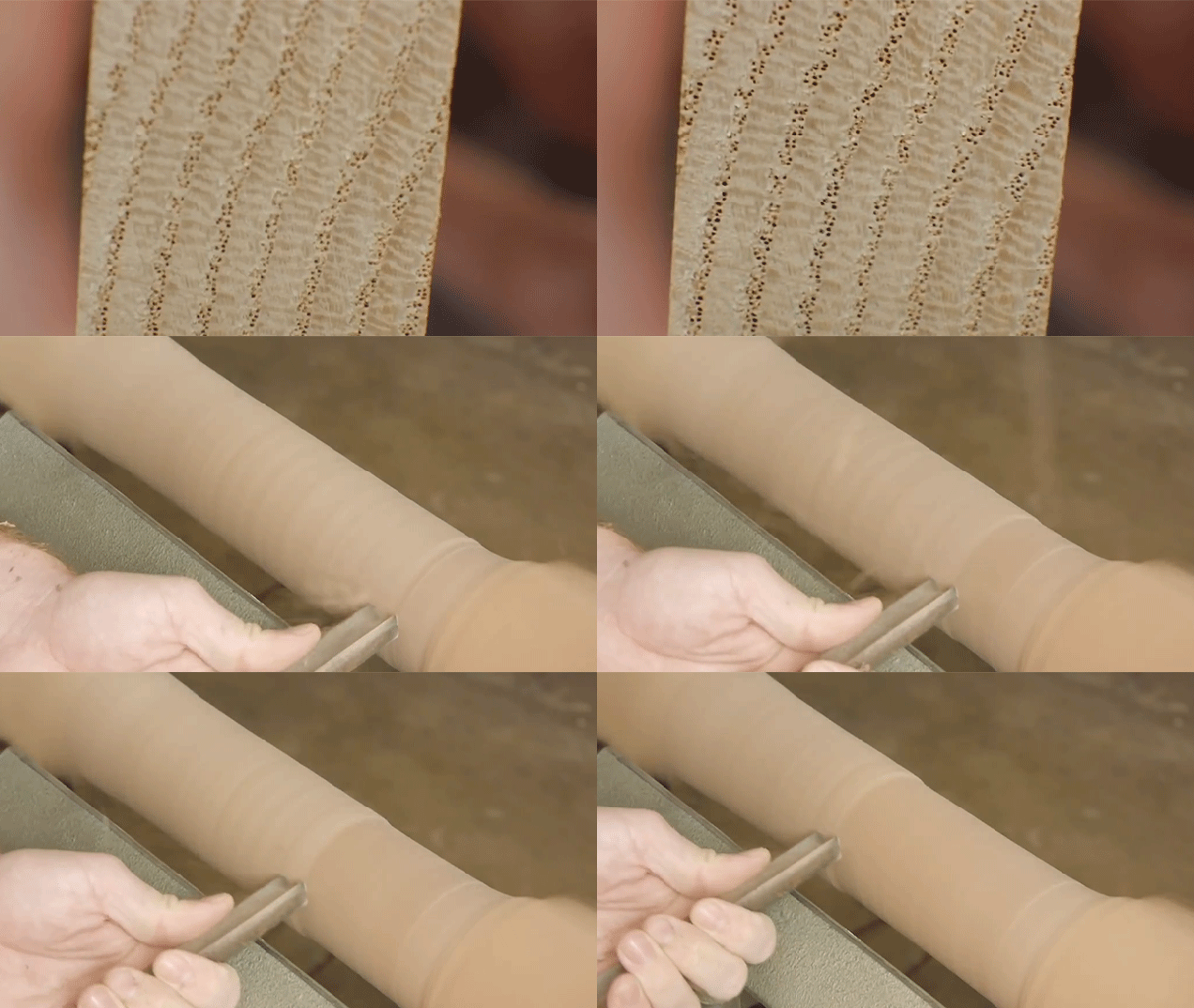
Shattering bats are dangerous for both the players and the fans. Why do bats shatter? Why did the incidence jump? 

Source: The Reason Baseball Bats Break Is More Complicated Than You Think Gizmodo, which  pulled the story from YouTube’s Practical Engineer.

Comment: In terms of technological knowledge, the shift from ash to maple wood for bats made some of the manufacturing and hitting knowledge obsolete. It took an MLB study to identify the problem. The solution was to adjust a seemingly minor design decision — the direction they place their logo. The intermediate causal variables were the different grain structures of the two woods.

Recently, bat-makers have started rotating their logos by 90 degrees on maple bats, as well as marking the grain on the handles. Bat breaks have gone down about 50 percent as a result

Decrypting the iPhone – some speculation

The NY Times says nobody knows how the FBI decrypted the infamous iPhone. That is certainly true, but there is speculation about physically opening up one of its chips and reading its crypto key. http://www.nytimes.com/aponline/2016/03/29/us/politics/ap-us-apple-encryption.html Years ago, I looked at reverse engineering of chip designs by  physically disassembling them. Here are some comments on how difficult this is, although it certainly may be possible.

Physically attacking a chip is an old, but difficult, method of breaking into a system that you control. In 2008, Ed Felton and others read DRAM chips that had been turned off, by freezing them in liquid nitrogen. But they were reading the outside pins of the chip package. http://www.nytimes.com/2008/02/22/technology/22chip.html Partly to prevent that, but mostly for speed and cost reasons, processors like those inside a smart phone now include modules like graphics, cache, and security on the same die and chip. So there is no way to read such data from outside the package, unless a design has a bug.

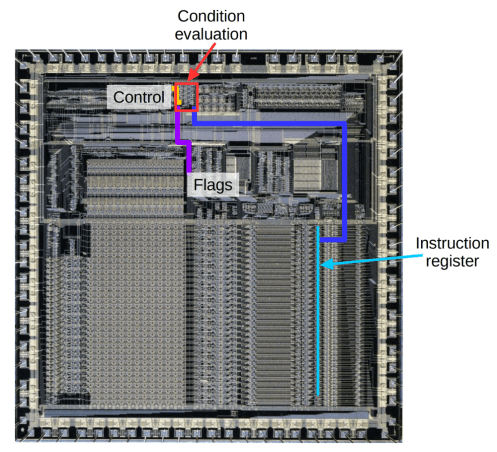
To read signals from inside a chip, you need to figure out the logical and physical layouts of the chip, which are proprietary and, with up to 100 million logic gates, very complex. Then you need to be able to inject and read signals with a physical separation of 100 nanometers(nm) or less. By comparison, the wavelength of light is 400 nm or greater. And the chip designers knew you might try, and perhaps did their best to make it impossible. Of course, companies still attempt to reverse engineer their competitors’ chips, so some expertise does exist.

chip-labeled

Finally, if you are physically slicing up a unique device, I would guess that one slip and you may not be able to recover. You can’t just shut off power and start over the way you can with software attacks.

Here is one example of successfully dissecting a security chip, back in 2010. It was not easy!


The Tesla Dividend: Better Internet Access — Interesting but Wrong

Elon Musk’s newest car doesn’t just run on electricity — it needs a world class fiber network  Source: The Tesla Dividend: Better Internet Access — Backchannel — Medium

This is an interesting attempt to give still more importance to Tesla and very smart cars. “Tesla cars generate about 1 Gigabyte per minute of [raw] data.”

But the argument is wrong. They generate plenty of data internally – so do today’s other advanced cars with their 100+ processors. But that data is thrown away as fast as it is created. It’s part of what I called “dark data” in my report on Measuring Information. Neither Tesla nor anyone else needs the massive detail. Even for deep learning, only a few seconds are going to be useful, per hour of operation. See my response to the original article, here.

The Hardware Startup Valley of Death — Bolt Blog — Medium

An interesting short article by Chris Quintero, about what goes wrong when hardware startups are ready to start selling actual production units.  The company faces simultaneous “manufacturing hell” and “fundraising hell.”

My response: It’s a good analysis, but it’s symptomatic of the problem that the author does not include a single recommendation about manufacturing.

Manufacturing 1000 units is a whole different world than making 10, and I’ve seen many idealistic startups founder because the team thinks they can outsource all the manufacturing issues (and, to the least expensive contract manufacturer). Not understanding tolerances and not designing for manufacturability, for example, cause months of delay, that eat cash needlessly and often fatally. But some startup teams don’t have this expertise. If you are in that situation, work with an appropriate US-based partner such as Leardon.com. (No affiliation except that one founder is a former student of mine.)

Source: The Hardware Startup Valley of Death — Bolt Blog — Medium

You can guess that this author knows mainly about finance and marketing. Classic MBA profile!  (I don’t know CQ and don’t know his background.)

Is technical knowledge fractal?

My analysis of technical knowledge in manufacturing, aviation, and elsewhere suggests that it is fractal, i.e. that any portion of a knowledge graph can be further decomposed into a detailed knowledge graph in its own right. Limits on human knowledge mean that the frontiers of current graphs are always “fuzzy,” i.e. at low stages of knowledge. Further technology development will clarify clarify the current periphery of a graph, but reveals new fuzzy portions.

To the extent this hypothesis is true, i.e. that knowledge is fractal, it has a lot of implications. For example, high-tech industries must operate in frontier regions where much is known, but some important issues are not well understood. People are better than machines at dealing with ambiguity, so the faster the rate of technological progress, the more an industry needs people and cannot automate its activities.


Zika virus: Forbes columnist can’t bear to say “market failure”

Here’s a column by a Forbes blogger about Zika saying that “we should not wait so long to develop vaccines against tropical diseases.” He concludes:

 Many pharmaceutical companies don’t focus on a disease until it becomes common enough to be highly profitable. The trouble is the vaccine world has become a bit like the plot line for “She’s All That” or “Cinderella.” Attention towards a person or thing does not occur until a cool person notices he or she or it. But when it comes to disease and stock market opportunities, as the saying goes, once your grandmother knows about it, it is usually too late.

Source: Zika Vaccine: Another Example Of Waiting Until It’s Too Late? – Forbes

This is not news. And it’s a classic situation where market forces are not enough to give socially desirable behavior. Developing a vaccine for a disease that is not in rich countries has low expected profitability. Even if the disease goes epidemic, pharma company will have to sell at a price near marginal cost.

The only solution is to use a different way to fund development. Contests, grants (Gates foundation), purchase guarantees (used by US DoD) all work. But waiting for the traditional patent system + pharma profit motive won’t lead to timely development of medication for poor-country diseases.

I guess a Forbes columnist is not allowed to point this out.