Art and science of baseball bats

Shattering bats are dangerous for both the players and the fans. Why do bats shatter? Why did the incidence jump? 
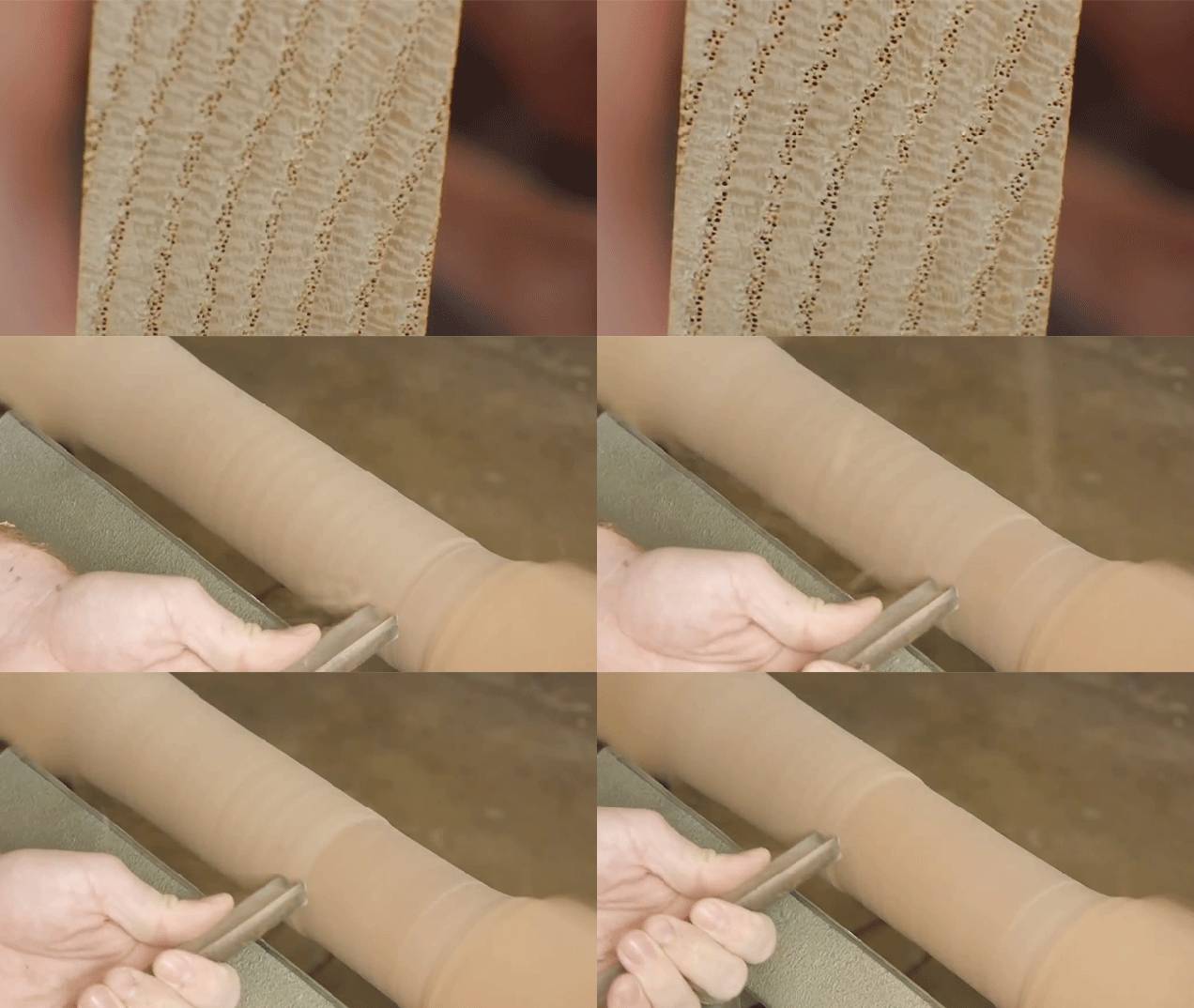
Source: The Reason Baseball Bats Break Is More Complicated Than You Think Gizmodo, which  pulled the story from YouTube’s Practical Engineer.

Comment: In terms of technological knowledge, the shift from ash to maple wood for bats made some of the manufacturing and hitting knowledge obsolete. It took an MLB study to identify the problem. The solution was to adjust a seemingly minor design decision — the direction they place their logo. The intermediate causal variables were the different grain structures of the two woods.

Recently, bat-makers have started rotating their logos by 90 degrees on maple bats, as well as marking the grain on the handles. Bat breaks have gone down about 50 percent as a result

The Hardware Startup Valley of Death — Bolt Blog — Medium

An interesting short article by Chris Quintero, about what goes wrong when hardware startups are ready to start selling actual production units.  The company faces simultaneous “manufacturing hell” and “fundraising hell.”

My response: It’s a good analysis, but it’s symptomatic of the problem that the author does not include a single recommendation about manufacturing.

Manufacturing 1000 units is a whole different world than making 10, and I’ve seen many idealistic startups founder because the team thinks they can outsource all the manufacturing issues (and, to the least expensive contract manufacturer). Not understanding tolerances and not designing for manufacturability, for example, cause months of delay, that eat cash needlessly and often fatally. But some startup teams don’t have this expertise. If you are in that situation, work with an appropriate US-based partner such as Leardon.com. (No affiliation except that one founder is a former student of mine.)

Source: The Hardware Startup Valley of Death — Bolt Blog — Medium

You can guess that this author knows mainly about finance and marketing. Classic MBA profile!  (I don’t know CQ and don’t know his background.)

Is technical knowledge fractal?

My analysis of technical knowledge in manufacturing, aviation, and elsewhere suggests that it is fractal, i.e. that any portion of a knowledge graph can be further decomposed into a detailed knowledge graph in its own right. Limits on human knowledge mean that the frontiers of current graphs are always “fuzzy,” i.e. at low stages of knowledge. Further technology development will clarify clarify the current periphery of a graph, but reveals new fuzzy portions.

To the extent this hypothesis is true, i.e. that knowledge is fractal, it has a lot of implications. For example, high-tech industries must operate in frontier regions where much is known, but some important issues are not well understood. People are better than machines at dealing with ambiguity, so the faster the rate of technological progress, the more an industry needs people and cannot automate its activities.


Airbus design again contributes to crash

One contributor to the A320 crash off Brazil in 2009 (Air France 447) was that the two pilots were making opposite inputs on their control sticks. The aircraft was in a stall, and therefore it was crucial to push the nose down, to regain airspeed. The instinctive human reaction (of untrained people) is to pull the nose up, since the airplane is falling. To oversimplify a long sequence of events drastically, pilot made the correct move, but the other pilot apparently panicked, and pulled back on his control stick. He continued to do this as they fell from 40,000 feet all the way to the Atlantic Ocean.

A new accident report says that the same thing happened in the crash of an  Indonesia AirAsia Airbus A320, flight QZ8501, last year.

Continue reading

The amazing story of Apple’s chips

With the new A9 and A9X chips in its iPhones and iPads, Apple has mobile chips that are better than Intel’s. In fact Apple’s chip business is a very impressive technology story. I don’t have time to put together a full analysis, but I have collected some recent articles. figure-2

Many sources are suggesting that Apple’s current chip generation (A9 and A9X) is better than Intel’s in low-power (mobile) performance. I guess it’s not news that Intel is behind Qualcomm in mobile, but I still find it surprising that Apple’s own chips are apparently better than X86 for Macintosh low-end laptops!

Continue reading

Autonomous vehicles – how skeptical should we be?

I have gone up and down on the prospects for  autonomous vehicles (AVs). There are a lot of technical hurdles, and probably as many social issues such as how liability laws will be written. The Google car has been over-hyped. But today I received a claim that AVs are not feasible until 5G wireless networks are ubiquitous.

Continue reading

Is the FDA Too Conservative or Too Aggressive?

I have long argued that the FDA has an incentive to delay the introduction of new drugs because approving a bad drug (Type I error) has more severe consequences for the FDA than does failing to approve a good drug (Type II […]

Source: Is the FDA Too Conservative or Too Aggressive?

My take: this paper by  Vahid Montazerhodjat and Andrew Lo is interesting, but it only looks at one issue, and there are many other problems that make overapproval more likely. There are many  biases in the drug pipeline and FDA approval process, most of which are heavily in favor of approving drugs that do nothing (and yet, still have side effects). To mention one of many, the population used to test drugs is younger, healthier, more homogeneous, and more compliant than the population that ends up actually taking the drug. A second bias is that the testing process screens out people who have major side effects – they stop taking the drug, and are dropped from the sample (and from the statistical analysis at the end). So we only see the people with moderate or no side effects. Both of these problems lead to biases, which better statistical methods cannot remove.

The paper is interesting, but it is working from an idealized model of the drug research process, and I would not take its quantitative results seriously. The basic logic seems sound, though: there should be different approval standards for different diseases.