Going back to school again – a shopping list | The Thesis Whisperer

Hardware and software list for new PhD students. It’s a good starting place. (I guess February is the start of the new academic year “Down Under.”)  Source: Going back to school again – a shopping list | The Thesis Whisperer

My additional suggestions:
1. Reference manager software is essential. EndNote is radically overpriced and behind in terms of features, but unfortunately is standard in certain fields. There are open source alternatives (Zotero). I use Bibdesk, which is only about $50.

2. A document manager is also essential. And I disagree with her comment about using a different manager for each source (PDF, web pages, etc.) To start with, Evernote is an OK but very lightweight document manager – it is not easy to find things once your library gets large (I have > 10,000 documents, but that is after years in academia). Better alternatives are:

  • EagleFiler
  • Devonthink (much more complex and correspondingly harder to learn, but also more powerful. For example, you can link to specific locations inside documents).
  • Both of these allow you to store ALL kinds of documents and to easily display, search, reorganize, and annotate them while still in the main application. For web pages, you have the option of storing as HTML, or converting to PDF.
  • A third option, which went through years of bugs but is apparently now OK, is Papers (papersapp.com). But it only has native support for PDF – everything else has to be stored as PDF. Still, if I were starting over I would give it a serious look.
  • Finally, Bibdesk or other reference managers may be OK for managing documents, although I’ve never tried it.

Scrivener and its ilk for writing you have discussed elsewhere.
Ridiculous: “Why Oxfam is getting it wrong about poverty” – CapX

Bilge from a right-wing pseudo-intellectual. I’ve never heard of this guy before, but he seems to be an expert in deception rather than analysis.

As it’s Davos time, Oxfam has issued its traditional demand for a handout.  Their wealth report this year informs us that a mere eight people have more wealth than the bottom 50 percent of the world’s population. This is entirely true of course. But Oxfam’s solution is that we should take it from the rich and […]Source: Why Oxfam is getting it wrong about poverty – CapX

This is an example of deceptive reasoning. Here’s my quick analysis:

Worstall writes:

>The result is that entrepreneurs get to keep some 3 per cent of the value of their creations. The other 97 per cent of the value flows to us consumers out here.
….
>Poverty exists and obviously we’d prefer that it didn’t. That’s why we need more rich people not fewer: because we need someone to create value for the rest of us to consume.

So he is equating “rich people” to “entrepreneurs” to “creators of value.” If only that were true. Although a small number of tech entrepreneurs get most of the publicity (Steve Jobs, Bill Gates, etc), most of the giant corporate profits are coming from increasing market power/decreasing competition in many markets. For example, few outside the industry think that the “financial services” industry (e.g. investment banking) creates value comparable to the huge profits it makes.

He is also using misdirection to imply that Sam Walton’s heirs were the entrepreneurs who created Walmart’s economic value!

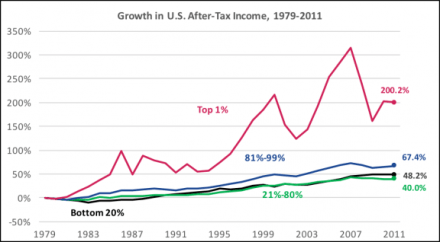
Finally, he keeps using a “3 percent” number to imply that “the masses” get 97 percent of increasing economic value, and the ultra-rich get only 3 percent. In fact median income has not grown for several decades. While the overall GDP has doubled in the last 30 years, the extra income has gone entirely to the upper ten percent. (Median household income rose by 8% in the last 30 years.)
Sources: http://www.multpl.com/us-gdp-inflation-adjusted/table
https://fred.stlouisfed.org/series/MEHOINUSA672N

A slightly different way of measuring. Compare black and red lines.

figure-9-e1455724425470

So the blog post is a dishonest piece of fallacious reasoning. Is this typical of the Adam Smith Institute, where he is apparently based? Is this the average reasoning level of right-wing intellectuals today?

By the way, I’m sure there are problems with Oxfam’s report – just not the ones he claims.

Standards wars in home automation: don’t spend big $ yet

19542-285f330fe7918bc83dbe3ba172c81cc2
TL;DR It will take 5+ years for standards to get sorted out in home automation. Until they are, devices from different companies will not be compatible. Anything that you buy and install now will be inconvenient (you will need multiple interfaces) and become obsolete in a few years.

Now that there are many genuinely useful and modestly priced home automation devices (and I don’t mean smart refrigerators), we are ready to enter the rising portion of “the S curve” where penetration increases. Most of the devices can be retrofit, which will make uptake much easier.

But right now, most vendors have their own protocols. Common protocols are needed at 3 layers:  the user interface, such as a mobile phone/computer app (or web site), physical communication such as Bluetooth, Zigbee, or Wi-Fi, and data protocols (API’s, essentially). Most vendors appear to be moving toward a hub and spokes arrangement, where the hub handles communication to the user and outside the home, so there will also be competition for whose hub customers buy. Finally, I would add security as its own “layer,” since it is so important and currently completely neglected.

Continue reading

Leave Your Laptops at the Door to My Classroom 

The research on this seems pretty overwhelming: laptops and cell phones in class hurt learning. Related issue: learning to listen.

Unfortunately in my more quant courses, they can be necessary at times. But if I had a way to turn off the Internet, I certainly would. (FCC makes wireless jamming illegal – for good reason.)

For my former students in BGGE: Hong Kong Disneyland, reprised

Prof. Steph Haggard and I taught a course on government/private sector relationships for many years, called BGGE (business and government in the global economy – pronounced “big-e”). One of the cases was a 2-day slog through the negotiations between Walt Disney Corp.(WDC) and the Hong Kong government, about setting up the first Disney theme park in China.

The punch-line of the case was that WDC would win whether the park was profitable or not, because it received royalties as a fraction of the gross revenue. It also extracted lots of favorable financing from the HK government.

According to this article, one of the feared scenarios in the case has happened. WDC built a second Disney park in China (Shanghai), and within six months of its opening, it is siphoning away visitors. And sure enough, it looks like WDC and the HK government are playing the same game again: pumping subsidies into the park to boost attendance, with the side effect of helping WDC.

Source: Hong Kong Disneyland, Seeking Return to Profit, Plans $1.4 Billion Upgrade – The New York Times

Excerpts:

But the scope of the enhancements also reflects the difficult spot in which Hong Kong Disneyland finds itself. Despite more than $600 million in added attractions in recent years, including three new themed areas and a nighttime parade, the park lost about $20 million last year, according to financial filings.

The renewed focus on Hong Kong Disneyland, with its lush gardens and collection of classic Disney rides, comes just six months after the opening of the Shanghai resort, which generated global headlines for its opulence. Disney has suggested that the Shanghai park will attract 10 million visitors in its first year; four million people visited in the peak summer months alone.

Hong Kong leaders, already feeling insecure about the ascension of Shanghai as a financial capital, do not want their Disneyland to be viewed as a lesser property.


“My Galaxy Note7 is still safer than my car.” No, it isn’t.

The odds of dying in a car wreck are twice as high as this thing “exploding.” I’m keeping it.

Source: My Galaxy Note7 is still safer than my car. I’m keeping it

This author does an interesting calculation, but he does it wrong. The 100 Note7s that have exploded, out of 2.5M sold, were all used for 2 months or less since the phone has only been on the market that long. When you correct for this, the rate of fires over a 2 year ownership period is roughly 1 in 1000. (Probably higher, for several reasons.)

Second, lithium battery fires are nasty, smelly, and dangerous because they can set other things on fire. I speak from personal experience. Do you want to leave a device plugged in at night that may have a .1% chance of burning your house down over the period that you own it? I hope not.

His car wreck odds calculation (1 in 12000), by the way, may be per-year, but again he does not realize that it matters. But he is right that cars are plenty dangerous. I once estimate that at birth an American has a 50% chance of being hospitalized due to a car accident during their lifetime.

There are many other TOM issues to do with this Samsung Note7 recall. Clearly they have internal problems, and problems somewhere in management.

Medicine Grand Rounds at Stanford

Yesterday I gave a Grand Rounds presentation at Stanford Med School. My title was

Craft, Standardization and Automation: Powerful yet Perilous Paradigms for Control when Lives are at Stake

Most of my talk was about the adoption of procedures (checklists) by US military aviation, during and after WW II. It has close analogies to the situation of health-care today.  Here is my short presentation.  A much longer presentation, with more examples but without discussion of medicine, is here.

Initially, I was concerned that my topic might seem too esoteric for Stanford’s medical faculty. However, their Medical Grand Rounds program covers a lot of ground. My topic was only 1.5 standard deviations away from the mean.

For more of my research on flying paradigms and how technologies evolve from crafts to sciences, please see this page.