Chartjunk: Second-worst graphic of the month!

A bad graphic from a pro-solar group is perhaps not surprising. (See previous post.) Here is one from Bloomberg  that verges on incomprehensible. Bloomberg as a source is surprising.
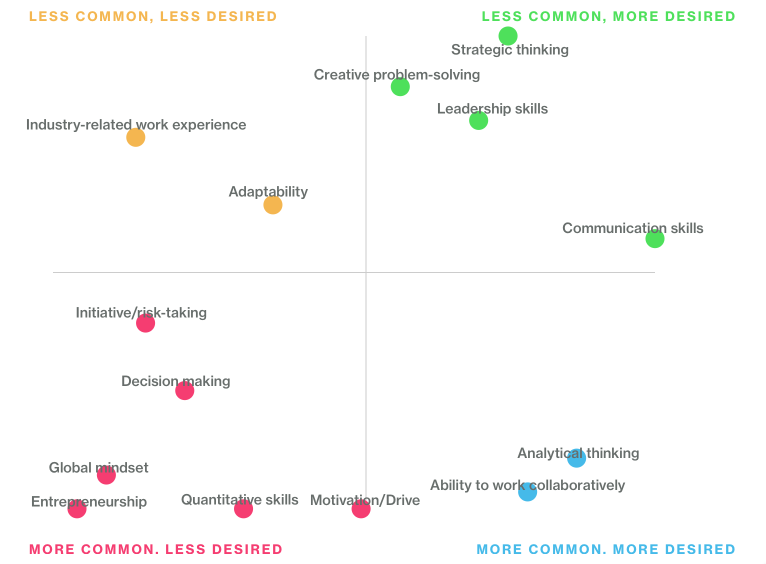
Which way is up? (Answer: down is up)

Which way is up? (Answer: down is up)

Looking closer, it appears that Skill Desirability increase from left to right, and Skill Frequency increases from top to bottom?!  Graphs should be drawn so that UP means higher.  In any case, it should not take prolonged inspection to deduce which variable is on the X axis.

The graphic also manages to make as many schools as possible look good at something. In Financial Services, the top 3 schools for Communications skills are listed as  Tuck, McCombs, and Kellogg. But in Technology, the top 3 schools change to Fuqua, Haas, and Kellogg. And for Consulting, the top 3  are London, Harvard, and Ivey. Since “Communication Skills” are the most desired skill of all according to the graph, eight schools can say they are in the Top 3 for teaching the most sought-after skills.

Facebook AI Director on “Deep Learning”

This short interview has some good explanations.

LeCun: Actually, I think the basics of machine learning are quite simple to understand….

A pattern recognition system is like a black box with a camera at one end, a green light and a red light on top, and a whole bunch of knobs on the front. The learning algorithm tries to adjust the knobs so that when, say, a dog is in front of the camera, the red light turns on, and when a car is put in front of the camera, the green light turns on. You show a dog to the machine. If the red light is bright, don’t do anything. If it’s dim, tweak the knobs so that the light gets brighter. If the green light turns on, tweak the knobs so that it gets dimmer. Then show a car, and tweak the knobs so that the red light get dimmer and the green light gets brighter. If you show many examples of the cars and dogs, and you keep adjusting the knobs just a little bit each time, eventually the machine will get the right answer every time.

Why unsupervised learning is critical in the long run, but does not yet work:

The type of learning that we use in actual Deep Learning systems is very restricted. What works in practice in Deep Learning is “supervised” learning. You show a picture to the system, and you tell it it’s a car, and it adjusts its parameters to say “car” next time around. Then you show it a chair. Then a person. And after a few million examples, and after several days or weeks of computing time, depending on the size of the system, it figures it out.

Now, humans and animals don’t learn this way. You’re not told the name of every object you look at when you’re a baby. And yet the notion of objects, the notion that the world is three-dimensional, the notion that when I put an object behind another one, the object is still there—you actually learn those. You’re not born with these concepts; you learn them. We call that type of learning “unsupervised” learning.

Facebook AI Director Yann LeCun on His Quest to Unleash Deep Learning and Make Machines Smarter – IEEE Spectrum.

When the doctor’s away, the patient is more likely to survive | Ars Technica

When the doctor’s away, the patient is more likely to survive | Ars Technica.

Very surprising. When cardiologists are away from the hospital, deaths after heart failure or cardiac arrest declined. I’ll probably use this in my course this Spring. (Or perhaps in both courses: Big Data, and Operations Quality in Healthcare.)

Continue reading