I have gone up and down on the prospects for autonomous vehicles (AVs). There are a lot of technical hurdles, and probably as many social issues such as how liability laws will be written. The Google car has been over-hyped. But today I received a claim that AVs are not feasible until 5G wireless networks are ubiquitous.
Art to science
First FAA-Approved Drone Delivery Is a Success, but Does It Matter? – IEEE Spectrum
First FAA-Approved Drone Delivery Is a Success, but Does It Matter?
I’ve been tracking the potential for drone (Autonomous vehicle) delivery of packages since before Amazon proposed it. I’m generally very skeptical that it can play a major role in delivering routine packages. And I certainly thought Amazon’s claimed timetable was blowing smoke. (As it turned out to be.)
Basic issues include safety, landing somewhere in urban areas, weather (except where I live) and payload/range/weight. Longer range or bigger payload require a larger vehicle, which is more of a potential safety hazard. Micro navigation (phone poles) might also be a problem, as stated in this IEEE article, but I can envision technical solutions to that issue.
Here is a 2013 IEEE article that makes the basic anti-Amazon case. Amazon was talking about being ready in 2015!
Yet over a longer period, say before 2020, there are niche applications that will be feasible. Whether they will be economically sensible remains to be seen. Rather clearly, deliveries will start with small, high-value, urgent packages. Here’s a video about a rural demonstration of delivering meds.
Here is my comment to someone who said drone delivery was impossible because of theft and safety.
Theft is an issue, but there are many potential partial solutions. For example, once stolen the drone would not function. (It could still be stripped for parts, but that has possible solutions as well.) So it becomes an arms race/incentive system, just like stealing packages from your front door.
Safety is an issue in cities, but suppose the drones become as safe as a delivery truck driving through your neighborhood. A six rotor drone is pretty robust. Safety is less of an issue in some regions. And there may even be ways to “crash safe,” including airbags, parachutes, etc.
Regulatory fear is likely to continue to be a big issue in the USA. In my opinion, that is a shame, and will destroy the US lead in the technology (for which there are many good applications – just probably not package delivery). So I’m glad to see Amazon is taking a role in proposing sensible regulation.
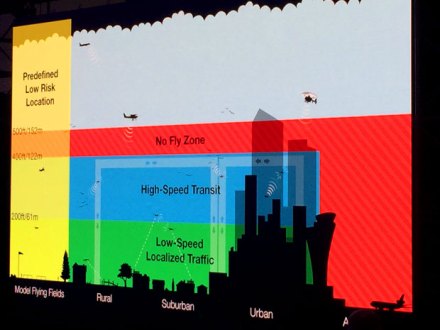
General drone technology clearly has a productive future. But my guess is that the US will be pushed aside by other countries that are less hung up about regulating every possible problem. (E.g. Australia?)
Why RC drones won’t be a danger to small planes
The rules for flying radio controlled aircraft are under tremendous debate and change, mainly because of two new technologies that have together created a new business. The technologies are tiny flight management systems costing about $100, and excellent lightweight cameras like the GoPro (invented by a UCSD grad). The new business is using drones for low-altitude photography (and eventually for other applications, although IMO not for package delivery).
Congress put the Federal Aviation Administration in charge of figuring out what rule changes are needed. So far it has done a slow and weak job. (One result is that the U.S. has lost leadership of the industry, and may even become a backwater. That is a topic for another day.)
Pilots are instinctively concerned about risks to manned aircraft, from unmanned aircraft. Much argument back and forth has ensued, but there is little or no modeling or investigation. (What happens when a 2 pound quadcopter collides with small plane at 140 knots? Apparently there have been zero experiments on the issue.) Here is an interesting blog post on this issue.
Why See and Avoid Doesn’t Work – AVweb Insider Article.
My take on this issue is that the likelihood of serious air-to-air collisions is tiny. Far fewer than bird strikes, for example. A much bigger sour of injuries will be untrained idiots flying drones over crowds of people.
NIH getting more serious about publishing clinical trial results
Under-reporting of clinical trials has been a problem for for decades (if not more). Only in the last few years has the medical community realized the pernicious effects this has on our knowledge about “what works” in medicine. If “bad” results don’t get permitted, all kinds of problems ensue, such as overly-optimistic views of new drugs, repeating of expensive and potentially dangerous research, and general waste of money. Since the NIH is such a big funder of medical research, this affects taxpayers too!
In any case, the NIH continues its slow (but steady?) crackdown on this issue. They are even threatening to cut off funding for researchers who don’t make their results available! (Of course a lot of research is funded by pharmaceutical companies, so this is hardly a comprehensive threat.)
I track this kind of thing because of my interest in “How societies learn” about technology. Forgetting and ignoring are powerful forces in retarding learning.
Sharing and Reporting the Results of Clinical Trials
Kathy L. Hudson, PhD1; Francis S. Collins, MD, MPH1
JAMA. Published online November 19, 2014. doi:10.1001/jama.2014.10716
… on the Delusions of Big Data … Interview from IEEE Spectrum
I agree 100% with the following discussion of big data learning methods, which is excerpted from an interview. Big Data is still in the ascending phase of the hype cycle, and its abilities are being way over-promised. In addition, there is a great shortage of expertise. Even people who take my course on the subject are only learning “enough to be dangerous.” It will take them months more of applied work to begin to develop reasonable instincts, and appropriate skepticism.
As we are now realizing, standard econometrics/regression analysis has many of the same problems, such as publication biases and excess re-use of data. And one can argue that it’s effects e.g. in health care have also been overblown to the point of being dangerous. (In particular, the randomized controlled trials approach to evaluating pharmaceuticals is much too optimistic about evaluating side effects. I’ve posted messages about this before.) The important difference is that now the popular press has adopted Big Data as its miracle du jour.
One result is excess credulity. On the NPR Marketplace program recently, they had a breathless story about The Weather Channel, and its ability to forecast amazing things using big data. The specific example was that certain weather conditions in Miami in January predict raspberry sales. What nonsense. How many Januaries of raspberry sales can they be basing that relationship on? 3? 10?
Why Big Data Could Be a Big Fail [this is the headline that the interviewee objected to – see below]
Spectrum: If we could turn now to the subject of big data, a theme that runs through your remarks is that there is a certain fool’s gold element to our current obsession with it. For example, you’ve predicted that society is about to experience an epidemic of false positives coming out of big-data projects.
Michael Jordan: When you have large amounts of data, your appetite for hypotheses tends to get even larger. And if it’s growing faster than the statistical strength of the data, then many of your inferences are likely to be false. They are likely to be white noise.
Spectrum: How so?
Why Malaysia Air 370 could not have been remotely controlled
I recently visited some friends and colleagues at Wharton to discuss my work on evolution of flying. Naturally, Malaysia Air MH370 came up. We have continued the discussion by email since I got back. Here is a note I wrote, explaining why it’s impossible to preprogram a flight plan so that the pilots could not override it, if they were conscious.

Notice the automatic circling when it reached Athens. Everyone onboard was dead.
Sid, overriding manual override is designed to be impossible. The pilots always have override. Indeed, the first 2 items on some emergency procedures are:
1) Disengage autopilot
2) Disengage auto throttle
and there are specific buttons to make that easy to do in a hurry. (As well as by going into the Flight computer and reprogramming it, or rebooting it, etc. ) Continue reading
Latency in UAV operation (geeky)
An interesting question about how much latency is acceptable for UAV operation. http://lnkd.in/dx-BfVk My answer, based partly on my radio control flying experience, is that it depends heavily on the context. 200 milliseconds is too long for stunt flying, but not a problem for flying larger UAVs at higher altitudes. The operator has to “dial in” their reflexes to the situation, just as sailors do with different sizes of sailboats. Here’s an example where low latency is essential:
A seeming paradox is that longer latencies are acceptable only at higher Stages of Control. (See my draft book for discussion of this concept.) At the high end (what I call Computer Integrated Flying), if enough knowledge is embodied in the aircraft, the operator can pull back entirely from flying, and switch to “commanding” the aircraft.
 Art and Science in Technology - Roger Bohn's Blog