The worst graph in a decade?

The back page of IEEE Spectrum this month has, hands down, the worst graph I can remember ever. It takes information on media spending in different countries, and transforms it into a totally confusing picture.

Worst graph in a decade?

Worst graph in a decade?

  • The horizontal axis should be country, while color should be different media. They have it exactly backwards. As it is now, the stacking renders comparisons impossible. Continue reading

Scientists Seeking NSF Funding Will Soon Be Required to Submit Data Management Plans – US National Science Foundation NSF

NSF pushes for more data sharing on funded projects.  Good – let’s hope NSF starts a race with NIH. The culture of data privacy is (superficially) good for individual researchers, but hard to defend for society and for taxpayers. One area in which the wide push for “stronger Intellectual Property (sic) Rights” is going the other way.

Scientists Seeking NSF Funding Will Soon Be Required to Submit Data Management Plans.  Government-wide emphasis on community access to data supports substantive push toward more open sharing of research data …  In particular, on or around October, 2010, NSF is planning to require that all proposals include a data management plan in the form of a two-page supplementary document. The research community will be informed of the specifics of the anticipated changes and the agency’s expectations for the data management plans.

via nsf.gov – National Science Foundation NSF News – Scientists Seeking NSF Funding Will Soon Be Required to Submit Data Management Plans – US National Science Foundation NSF.

The real reason why Steve Jobs hates Flash – Charlie’s Diary

From Charles Stross’ blog. I agree that the PC is fast becoming a commodity – this time for real, and even for laptops. I’m thinking about replacing my MacBook Pro, and asking if I really want to spend $1700 when I could get equivalent hardware from HP for $500 less. (Answer: Yes. I value my time!)  His speculation on what comes next is provocative – he seems to think Apple has a better shot at making the shift than anyone else.

The App Store and the iTunes Store have taught Steve Jobs that ownership of the sales channel is vital. Even if he’s reduced to giving the machines away, as long as he can charge rent for access to data or apps he’s got a business model. He can also maintain quality whatever that is, exclude malware, and beat off rivals. A well-cultivated app store is actually a customer draw. It’s also a powerful tool for promoting the operating system the apps run on. Operating system, hardware platform, and apps define an ecosystem.Apple are trying desperately to force the growth of a new ecosystem — one that rivals the 26-year-old Macintosh environment — to maturity in five years flat. That’s the time scale in which they expect the cloud computing revolution to flatten the existing PC industry. Unless they can turn themselves into an entirely different kind of corporation by 2015 Apple is doomed to the same irrelevance as the rest of the PC industry — interchangable suppliers of commodity equipment assembled on a shoestring budget with negligable profit……

Here’s his conclusion.

This is why there’s a stench of panic hanging over silicon valley. this is why Apple have turned into paranoid security Nazis, why HP have just ditched Microsoft from a forthcoming major platform and splurged a billion-plus on buying up a near-failure; it’s why everyone is terrified of Google:

The PC revolution is almost coming to an end, and everyone’s trying to work out a strategy for surviving the aftermath.

via The real reason why Steve Jobs hates Flash – Charlie’s Diary.

How American Health Care Killed My Father – Magazine – The Atlantic

The problems with the US Health care system are at their root not so complicated. This author seems to have done a pretty good assessment, with a year of research. The “system” is very good at delivering elaborate procedures and medications; there are few incentives for anything else. And it turns out that elaborate procedures are a gamble.  The old joke was “The surgery was a success, but the patient died!” But it’s no longer a joke.

Like every grieving family member, I looked for someone to blame for my father’s death. But my dad’s doctors weren’t incompetent—on the contrary, his hospital physicians were smart, thoughtful, and hard-working. Continue reading

Can we really adjust to a 5m sea level rise?

I’ve always assumed that a 5 meter sea level rise would be catastrophic – is that too simple?

I have no patience with the “It isn’t happening” view of climate change, which to me is part of the anti-rationalist view of the world. (The battle over the relative merits of Faith and Reason was supposedly settled, at least in Europe, by the Enlightenment, and the supporters of Reason won.)  Pumping large amounts of greenhouse gasses into the atmosphere must increase temperatures, and the burden of proof is on those who claim that it hasn’t and won’t. But everything (else) is susceptible to analysis, with no presumption that any particular conclusion is valid.

One of the surprises I have run into is the seemingly small estimates of damages in, say, the next 50 years.  Continue reading

Toyota learns the tyranny of software complexity

A good column about Toyota’s acceleration mess. The author is a former electrical engineer at Ford, and discusses the complexity of the software that runs modern cars. He compares this problem with previous major recalls by other vendors. The comments to the post are good, too. Here’s an excerpt:

The system level error that Toyota made is not letting a brake signal override a throttle signal. I designed speed control systems at Ford, and everything was dependent on having a tap on the brake cancel any speed control function. A throttle-by-wire car like Toyota makes is almost free to add speed control, you just have to have a button to tell the ECU (engine control module) to hold speed and a brake signal,

Continue reading

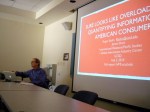
Roger Bohn’s February 3rd talk

Hello everyone! This is L. Lin Ong, the Graduate Student Researcher for the How Much Information? Project 2009 report. I have a few photos to share from Roger’s recent colloquium talk.

The talk was particularly interesting due to the post-presentation discussion regarding different philosophical viewpoints on information, an issue we grappled with during the early stages of the report.