HMI Bonus Material: Video Game Screenshots

Hello! Blake Ellison here, and I’m Roger’s newest grad student assistant. I’m interested in video games (both academically and personally), so I’m helping the team try to make sense of our findings that video games make up a huge proportion of our data consumption (when bytes are used as the measure).

A simple reason why video games comprise so much of our information  is the sheer volume of pixels that get transmitted to your eyeballs. A game running at 60 frames per second at 1080i on a current-generation console like the Xbox 360 is pumping out a huge amount of data. That’s to say nothing of hardcore PC gamers, who have what amount to miniature supercomputers sitting on their desktops.
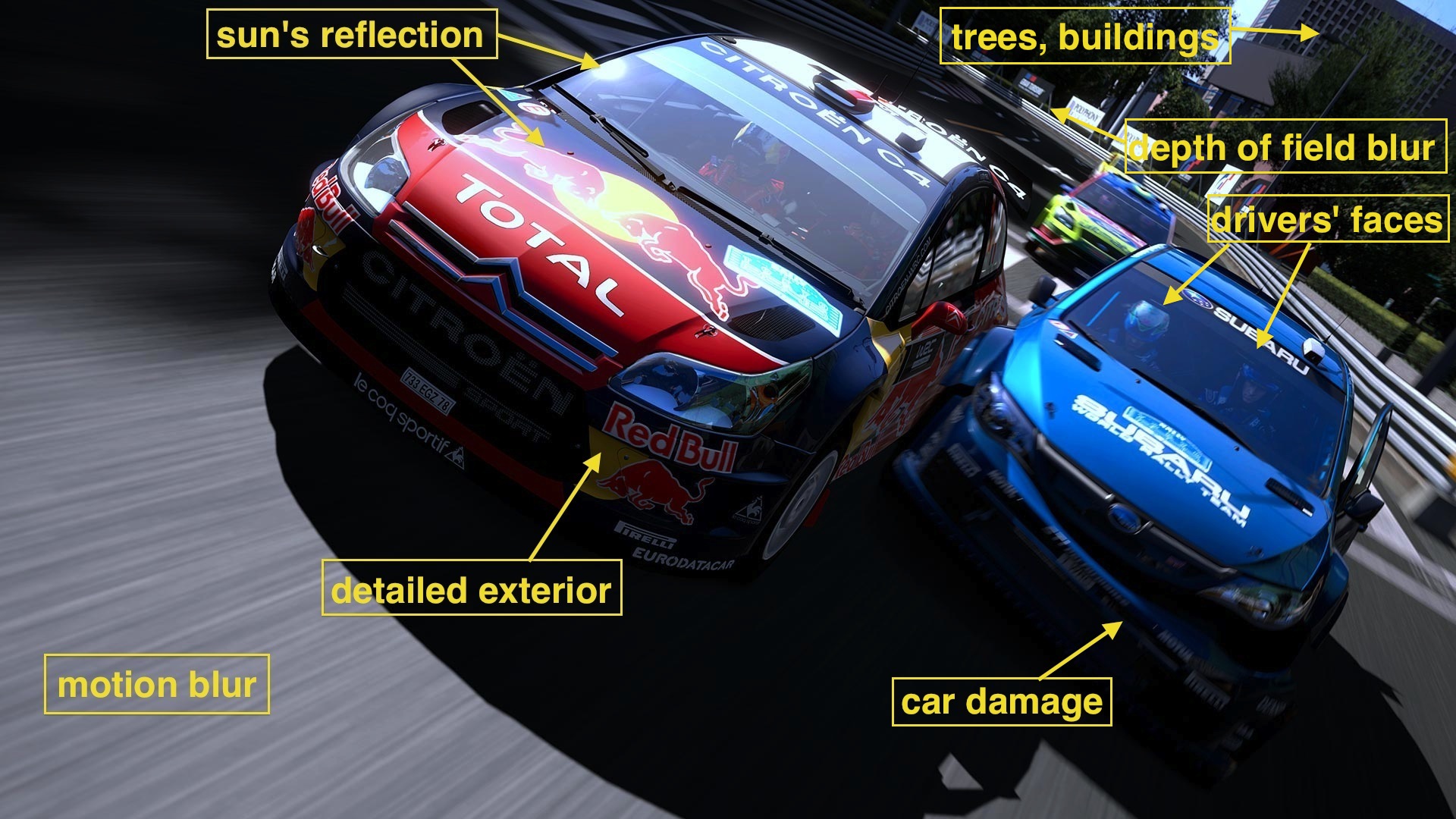
Polyphony Digital's Gran Turismo 5

These ‘supercomputers’ don’t have all that power simply to push out 1920 x 1080 pixels 60 times per second. They have the power to do all that and make it look good. Continue reading

Military Deluged in Drone Intelligence – NYTimes.com

By CHRISTOPHER DREW  Published: January 10, 2010

HAMPTON, Va. — As the military rushes to place more spy drones over Afghanistan, the remote-controlled planes are producing so much video intelligence that analysts are finding it more and more difficult to keep up.

Air Force drones collected nearly three times as much video over Afghanistan and Iraq last year as in 2007 — about 24 years’ worth if watched continuously. That volume is expected to multiply in the coming years as drones are added to the fleet and as some start using multiple cameras to shoot in many directions.

via Military Deluged in Drone Intelligence – NYTimes.com.

[Actually I’m surprised that the 24 multiplier is not higher, especially since some drones operate at night. On average, only 24 cameras are running.]

Airmen in air-conditioned rooms

HMI: Multitasking

We document a huge amount of information in our report How Much Information 2009 . Personally I find the 100,000 words per day as startling as the 34 gigabytes. Our report does not go into it, but there is some literature on how constant streams of information affect people. I’ve asked Lin Ong (RA) to pull together some articles, but here is a recent publication about the myth of multitasking, i.e. the claim that people can do several things at once and do them all well.  The underlying research the BBC discusses is published here. (fee or license required)

The people who engage in media “multitasking” are those least able to do so well, according to researchers. A survey defined two groups: those who routinely consumed multiple media such as internet, television and mobile phones, and those who did not. In a series of three classic psychology tests for attention and memory, the “low multitaskers” consistently outdid their highly multitasking counterparts. The results are reported in Proceedings of the National Academy of Sciences.

via BBC NEWS | Technology | Multitaskers bad at multitasking.

A Lifehacker column interviews another author on the subject. A psychiatrist with a book  on the human effects of overstimulation is discussed in a Business Week column for the frazzled.

Re-using CIA photos for research

The world is awash in data…. a lot of it can be re-used for other purposes. (Anecdote: Much of the early data on sea temperatures comes from the British Navy, whose ships routinely measured  a bucket of seawater every morning. Not exactly precise data, and using it requires estimates of things like how long the bucket sat on deck before being measured, and the accuracy of thermometers in the British Navy in 1800.)

The nation’s top scientists and spies are collaborating on an effort to use the federal government’s intelligence assets — including spy satellites and other classified sensors — to assess the hidden complexities of environmental change. They seek insights from natural phenomena like clouds and glaciers, deserts and tropical forests.

….

The trove of images is “really useful,” said Norbert Untersteiner, a professor at the University of Washington who specializes in polar ice and is a member of the team of spies and scientists behind the effort.

via C.I.A. Revives Data-Sharing Program With Environmental Scientists – NYTimes.com.

Query: What is Google doing to archive its maps and satellite imagery? I can’t imagine they get thrown away, but keeping full resolution versions of everything would be expensive.

The IPKat – happy to serve the IP communities: Letter from AmeriKat I: Happy Holidays!

Can anyone point  to more blogs on intellectual property  issues? Most of what I have found is industry-written and one-sided. Pamela Samuelson at Berkeley does not appear to have a blog. This is an area where academics are surprisingly consistent, but we don’t seem to be doing much talking about it. (Most academics I’ve talked to agree that current IP protections are much stronger than is good for society in general.)  Here’s one note that I found:

In Geneva last Tuesday the Obama administration announced before a subcommittee of WIPO that it supported the WIPO Treaty for Sharing Accessible Formats of Copyright Works for Persons Who are Blind or Have other Reading Disabilities. The Treaty would lessen international copyright protection in order to enable cross-border distribution of DRM-protected digitized books that blind and visually disabled individuals can read with tools like Pac Mate and Victor Reader. …..

Such a move, of course, puts the administration at odds with many US industries including software manufacturers and motion pictures.

via The IPKat – happy to serve the IP communities: Letter from AmeriKat I: Happy Holidays!.

Here’s another site that looks relevant:

http://www.publicknowledge.org/blog

Thanks.

How to lie with statistics – example 322

Paul Kedrosky reproduces some data on supposedly  fast growth industries:

According to a new study, here are the best and worst performing industries of the last decade as measured in revenue percentage change terms. Here are the leaders:

Some of these are doubtless valid, but the top 4 are all industries that had virtually no revenue at all in the 1990s, since they basically did not exist were not measured until Internet companies started to go public.  It’s easy to have an astronomical growth rate if you make the base number small enough. Startups do this a lot – “our revenue grew 1500% in our first 2 years.” That could mean they had $1000 of revenue in year 1, and $15000 in year 3!

“Anonymized” data frequently isn’t

An in-the-closet lesbian mother is suing Netflix for privacy invasion, alleging the movie rental company made it possible for her to be outed when it disclosed insufficiently anonymous information about nearly half-a-million customers as part of its $1 million contest to improve its recommendation system.

The suit known as Doe v. Netflix (.pdf) was filed in federal court in California on Thursday, alleging that Netflix violated fair-trade laws and a federal privacy law protecting video rental records, when it launched its popular contest in September 2006.

via Netflix Spilled Your Brokeback Mountain Secret, Lawsuit Claims | Threat Level | Wired.com.

(As the article goes on to make clear, this problem has been known for a while. Netflix ignored it at its peril.)