Basketball free throws are like WW2 aviation: nobody uses the best technique

Physics Proves It: Everyone Should Shoot Granny-Style | DiscoverMagazine.com.

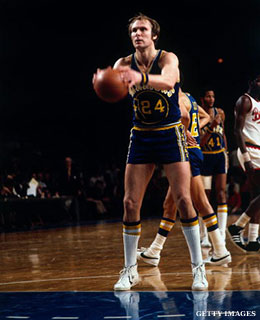
I’m writing about the slow and uneven adoption of Standard Procedure Flying (SPF) during World War 2. SPF is  superior, especially for newer pilots (which was who fought the war from 1943 onward, after the experienced ones were killed). So why didn’t everyone use it?? Analogy: free throw percentages in basketball are higher with underhand throws; but nobody uses it! Rick Barry is a legend who used it; but not even his sons followed him.Barry makes free throws into a “standard procedure.”

Rick Barry free throw

POMS talk: Aviation 1940 = Medicine 2005

B-17 Throttles

B-17 Throttles (Photo credit: rkbentley)

On Sunday I gave a capstone talk at the Production & Operations Society meeting in Denver.  I oriented my talk toward a comparison of health care now, with aviation’s transition to Standard Procedure Flying in the 1940s and 50s. BOHN POMS Standard procedure flying 2013e

As in medicine now, experienced expert flyers who did not use standard procedures were still better than newly trained pilots who did. And there was resistance to the changes. But aviation had a couple of advantages in making the transition: New pilots who did not learn SPF died quickly, usually in accidents. And the old experts got rotated out of combat positions (United States Army Air Force), or eventually got shot down no matter how good they were. (Germany)

Continue reading

Technology’s Real Benefits- NOT so much in cancer research

The first example is cancer research. … The genomic approach helps establish the right treatments today, and will likely lead to new and better drugs in the next few years. ….” this is something that will be useful 200 years from now. This is a landmark that will stand the test of time.”

via Technology’s Real Benefits (Hint: They’re Not Economic).

Sorry, Andy, we have been getting hype about contributions of computers to biotech, and biotech to cancer, for 20+ years.  It’s past time to be highly skeptical that medical breakthroughs are “around the corner… just give us another $X billion for research…” Although the research results have been fascinating, the practical impacts have been modest. I think one reason is that the Big Pharma/Big Academia model of R&D is  inefficient and ineffective. Everyone hoards their data, and pursues their own stove pipe. There’s little collaboration or interchange among computer modelers, in-vitro, animal models, epidemiologists, etc. This is not something that better technology can solve – it’s a problem with business incentives and the academic promotion system.

Case in point: According to a friend, there have been no Randomized Clinical Trials on the relationship between crystalline salt and kidney disease. Everyone assumes there is a relationship, but what is the exact causal link? What’s the magnitude? What are the mediators of the effect (e.g. different diets, different climates). And what effects do intervention at different points (diet versus medications) have?  This is not cancer research, but same principles hold.

Other benefits of technology: sure. Cultural and scientific and business. Mapping Inca ruins: awesome. Effect of Facebook on daily lives: large,and not captured in GDP statistics. So your basic thesis is good; just don’t use medical promises as cases in point!
Screening tests and invasive biopsies « Punk Rock Operations Research

screening tests and invasive medical procedures « Punk Rock Operations Research.

A nice blog post by Laura McLay on a few of the paradoxes of cancer screening, and the human reactions to it. Everyone should read this weekend’s NYT article on breast cancer screening, by Peggy Orenstein. Title is Our Feel-Good War on Breast Cancer.  One of my reactions to Peggy Orenstein being the author: age really does bring wisdom!

My extended family went through a scare caused by over-testing a few years ago. Nobody was at fault, but different family members have very different responses to uncertainty.

Here is the abstract to the article Laura mentions on prostate screening.

Debate regarding the prostate-specific antigen (PSA) screening test centers around test reliability and whether screening reduces mortality.1– 3 We consider yet another potential downside to the widespread use of unreliable screening tests: the downstream effect of receiving inconclusive or ambiguous results. When receiving information from screening tests, we usually want to know whether the result is a “yes” or a “no.” Receiving an inconclusive result amounts to a “don’t know”; this situation should have a level of uncertainty regarding the diagnosis similar to that of not conducting the test at all. Yet, we propose that the psychological uncertainty experienced after an inconclusive test result can lead to investigation momentum: additional, and potentially excessive, diagnostic testing. In contrast, not conducting the unreliable test would result in no further action. To investigate this, we evaluated whether receiving an inconclusive result from an unreliable test (the PSA screening), compared with undergoing no test, motivated more individuals to undertake an additional, more invasive and costly, test (a prostate biopsy).


Announcing new page for book excerpts: Daredevils to System Operators

I  have started a page devoted to excerpts from my book on art and science in flying. The first excerpt is about the invention of aviation checklists and related concepts, in the late 1930s. It turns out that the much-repeated story about a crash of a B-17 prototype is probably only partly true. The US Navy came out with a checklist at almost the same time.

Here is the page where I will post this and future excerpts.

How did flying go from an art to a science?

Why do doctors and lawyers practice their professions as an art, while pilots treat flying as a science? Is the comparison even appropriate? For several years I have been working on a book showing how flying changed from a dangerous art, to a very safe science. On this blog I will be posting excerpts from the book as it progresses. My goal is to entertain, and to get comments, corrections, and criticisms.

100 years ago, pilots (men and women) learned to fly by doing it. If they survived the learning process, they got good. Now, computers do most of the flying. Human pilots manage the computers, and communicate with other aircraft and with the ground, but they do very little direct hands-on flying. How did this situation come about? Is it an appropriate model for other industries, or are there unique circumstances for aviation that make it different?
My first excerpt looks at the origins of the Aviation Checklist, which is advocated by famous surgeon Atul Gawande and others. This style of flying was a re-invention of what engineer Frederick Taylor had done for manufacturing about 40 years earlier. In both, the idea was that some ways of flying/manufacturing were best. The best methods could be found, and taught to everyone.

Preventing baby-left-in-car deaths – suggestions from aviation

It’s a very hot summer, and that brings babies dying of heatstroke after they are accidentally left in a parent’s car. Years ago I thought “I could never make such a stupid mistake,” but after the research I’ve been doing on aviation safety, I no longer believe it. My own children are grown up, but many of my former students have small children, and it’s a terrible tragedy for anyone. So I’ve been thinking about how to reduce the incidence, using ideas from aviation.

<rant> One quick pet peeve: if you see someone’s  kid in a back seat looking unconscious, don’t stand around calling 911. Break the damned window and get them out! Yell at someone else to call 911I’ve seen multiple articles about people standing around in parking lots! </rant>

Continue reading