ANY product can be improved

For my upcoming product development class. A team, following the methods taught in the course, can improve the design of ANYTHING. A strong claim, admittedly.

Building a Better  Mailbox

It is often said that there are no new ideas, but Ms. Troyer and Mr. Farentinos turned that cliché inside out. By correctly anticipating how the high-tech future would change the way we shop, they updated one of the most low-tech items around: the repository of snail mail, the trusty mailbox. Along the way, they responded to a growing concern — identity theft — that established mailbox suppliers had failed to address.

via Prototype – Architectural Mailboxes – A Tale of Determination – NYTimes.com.

The course is based on the textbook by Ulrich and Eppinger:  http://www.ulrich-eppinger.net/

Broadband speeds increase – does it matter?

If this increase in broadband speeds is correct, the Internet will (finally) begin to make inroads on the number of bytes people receive, not just the number of words. According to our estimates, average effective bandwidth on the Internet was too low to send many bytes, compared with TV. (Remember how awful YouTube videos were in early 2008?) Partly this is because bandwidth in the last mile, which this report apparently covers, is not the only limit on throughput. Latency delays, limits on originating sites, and pauses by users all reduce average throughput. (This is very visible when I surf from UCSD, where I have speeds above 100 Mbps to my desktop. I still encounter delays.)

US Broadband Speeds Rose 28% in 2009SCOTTSDALE, Ariz., February 9, 2010 – The US residential broadband speeds continue to increase, albeit at a slower rate than in 2008. Between year-end 2008 and year-end 2009, downstream bandwidth rose by 28%, reports In-Stat http://www.in-stat.com.

via In-Stat – Press Releases.

The Internet already has a substantial fraction of average word consumption, because of the higher words-per-minute of reading over radio and TV.

If anyone knows of reliable data on average effective home Internet speeds, please send them along.

Latest development in the battle over vaccinations

The Lancet retracts paper linking MMR vaccines and autism By Matt Ford | Last updated February 3, 2010 9:27 AM

This week, after receiving the conclusions of a multiyear ethics investigation of UK doctor Andrew Wakefield performed by the General Medical Counsel GMC, the editors of British medical journal The Lancet formally retracted a study which purported to find a link between the childhood MMR vaccine, gastrointestinal disease, and autism. It was published in 1998 and has been a source of controversy ever since.

via The Lancet retracts paper linking MMR vaccines and autism.

This article is tale of greed and incompetence.  But the harm it did lives on. Here’s a site that claims to present “all sides,” but clearly thinks Wakefield is a hero. There are many like it – conspiracy theories flourish better than scientific analysis on the web. (More fun  and much easier to write, after all.)  For a good article on these hysterias, see an article by Amy Wallace in Wired.  As best I can tell, some  parents cannot handle the concepts of bad luck or Acts of God. If their child gets sick, someone is responsible! And it’s part of a widespread plot!

A second problem, much more widespread than the vaccine phobias, is that people have trouble dealing with small probabilities. (This observation goes back at least to research by Kahneman and Tversky on how humans have systematic cognitive biases.) So you can find nonsensical statements like “If screening for disease X [breast cancer screening under age 50 is the current example] saves even a single life, than not doing it is manslaughter.” What’s the problem? Screening itself causes difficulties, such as unnecessary biopsies. Not to mention that more lives might be saved by spending the same amount of money on something else. So deciding whether/when to get screened is a balancing act; it’s not all one way or the other.

One interesting bit of sociology (which to me is further proof that these health-scare controversies almost never have factual basis): most countries have phobias about vaccines and medicines, but the specific phobia varies by country. For example, the smallpox-eradication effort fell apart at the last moment when smallpox vaccine was rumored to cause infertility. (I’m looking for more specifics on the nation-specific fears of vaccines – I’ve forgotten where I came across it.)

Yet,  there are a LOT of problems with modern medicine, and with drugs in particular. But in an environment where any half-baked theory gets taken seriously, it’s very hard to separate the fear-mongering from the real problems.

The Lancet retracts paper linking MMR vaccines and autism

The Lancet retracts paper linking MMR vaccines and autism By Matt Ford | Last updated February 3, 2010 9:27 AM

This week, after receiving the conclusions of a multiyear ethics investigation of UK doctor Andrew Wakefield performed by the General Medical Counsel GMC, the editors of British medical journal The Lancet formally retracted a study which purported to find a link between the childhood MMR vaccine, gastrointestinal disease, and autism. It was published in 1998 and has been a source of controversy ever since.

via The Lancet retracts paper linking MMR vaccines and autism.

This article is tale of greed and incompetence.  But the harm it did lives on. Here’s a site that claims to present “all sides,” but clearly thinks Wakefield is a hero. There are many like it – conspiracy theories flourish better than scientific analysis on the web. (More fun  and much easier to write, after all.)  For a good article on these hysterias, see an article by Amy Wallace in Wired.  As best I can tell, some  parents cannot handle the concepts of bad luck or Acts of God. If their child gets sick, someone is responsible! And it’s part of a widespread plot!

A second problem, much more widespread than the vaccine phobias, is that people have trouble dealing with small probabilities. (This observation goes back at least to research by Kahneman and Tversky on how humans have systematic cognitive biases.) So you can find nonsensical statements like “If screening for disease X [breast cancer screening under age 50 is the current example] saves even a single life, than not doing it is manslaughter.” What’s the problem? Screening itself causes difficulties, such as unnecessary biopsies. Not to mention that more lives might be saved by spending the same amount of money on something else. So deciding whether/when to get screened is a balancing act; it’s not all one way or the other.

One interesting bit of sociology (which to me is further proof that these health-scare controversies almost never have factual basis): most countries have phobias about vaccines and medicines, but the specific phobia varies by country. For example, the smallpox-eradication effort fell apart at the last moment when smallpox vaccine was rumored to cause infertility. (I’m looking for more specifics on the nation-specific fears of vaccines – I’ve forgotten where I came across it.)

Yet,  there are a LOT of problems with modern medicine, and with drugs in particular. But in an environment where any half-baked theory gets taken seriously, it’s very hard to separate the fear-mongering from the real problems.
See Roger Bohn speak on HMI

Roger will be appearing at a UCSD colloquium on Wednesday, February 3, to discuss the results of the HMI project.

The event will be held in the Media Center / Communications building on campus (map here), and the nearest parking is just across the way on Muir College Drive. He’s scheduled to speak at 12:40PM in room MCC 201.

Here’s the official blurb:

How much information do Americans consume? At the start we have to define information, consume, and much.  All three definitions are unavoidably controversial. …

I will present and discuss our results, most of which are available in our report at hmi.ucsd.edu. We didn’t have strong expectations of what we would find, but we were surprised anyway. Continue reading

HMI Bonus Material: Video Game Screenshots

Hello! Blake Ellison here, and I’m Roger’s newest grad student assistant. I’m interested in video games (both academically and personally), so I’m helping the team try to make sense of our findings that video games make up a huge proportion of our data consumption (when bytes are used as the measure).

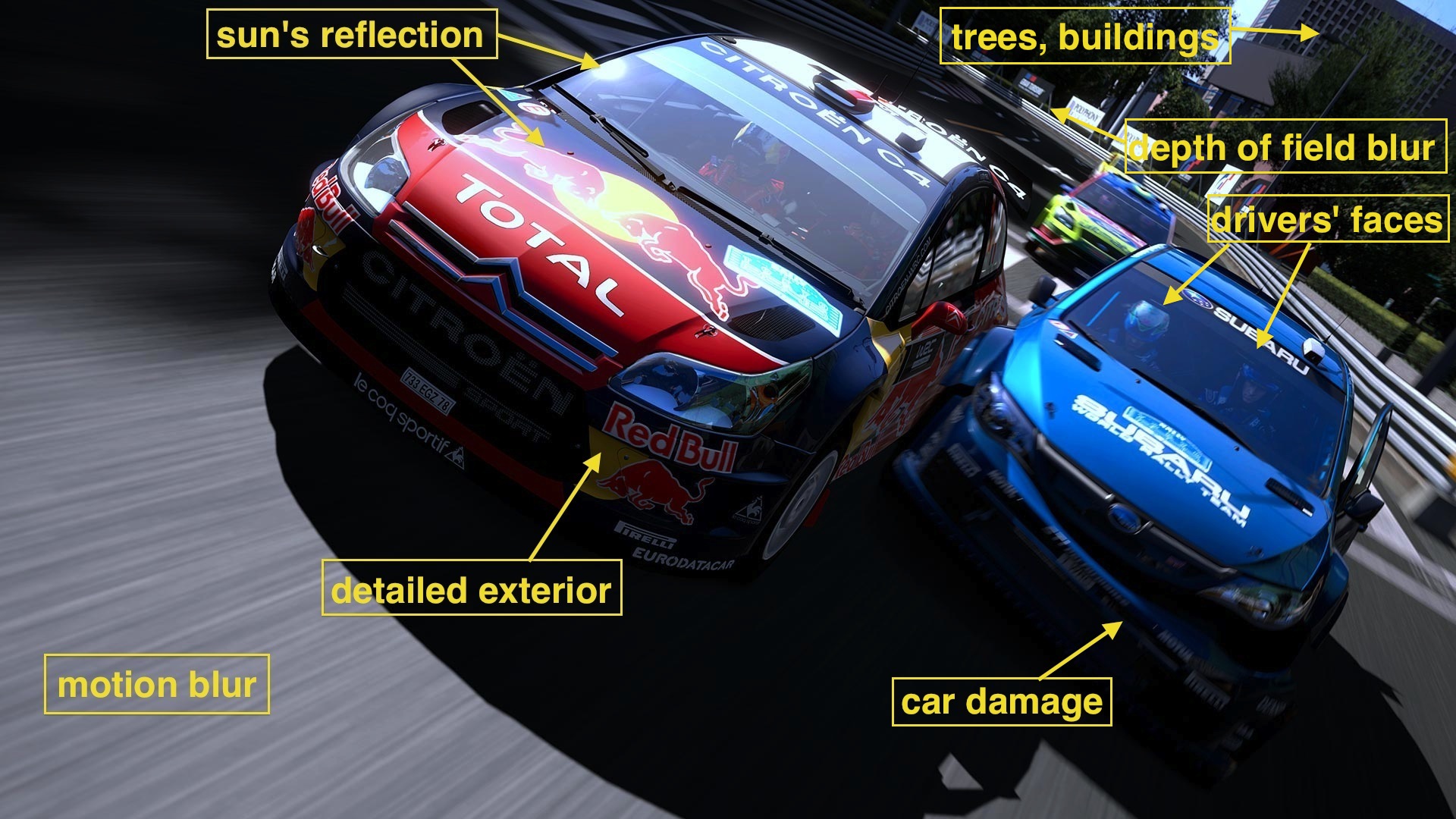
A simple reason why video games comprise so much of our information  is the sheer volume of pixels that get transmitted to your eyeballs. A game running at 60 frames per second at 1080i on a current-generation console like the Xbox 360 is pumping out a huge amount of data. That’s to say nothing of hardcore PC gamers, who have what amount to miniature supercomputers sitting on their desktops.

Polyphony Digital's Gran Turismo 5

These ‘supercomputers’ don’t have all that power simply to push out 1920 x 1080 pixels 60 times per second. They have the power to do all that and make it look good. Continue reading

Small is Beautiful for global health tech? A good theme for project proposals

(This presentation discusses the “car-parts neonatal incubator” in more detail, which  the NY Times profiled recently.  This is an example of appropriate technology. It would make a good takeoff point for projects in several of my courses.)

Many multinational companies manufacturing medical devices for developing countries focus their efforts on high-end products too expensive to be used in most healthcare settings. Unable to afford their own equipment, healthcare providers in areas with few resources often receive donated equipment from international organizations. Unfortunately, while this donated equipment is usually state-of-the-art, it often ends up falling into disrepair and eventually disuse. Donors with the best of intentions fall into the trap of donating equipment that the recipient cannot afford to maintain. Just as most of us would like to own a Ferrari but would be unable to pay for its upkeep, most clinics in resource-poor areas cannot afford to maintain expensive devices, such as incubators, designed for use in developed countries.

via CIMIT Forum: Medical Devices in Global Health: Idea to Implementation, Successes and Challenges.